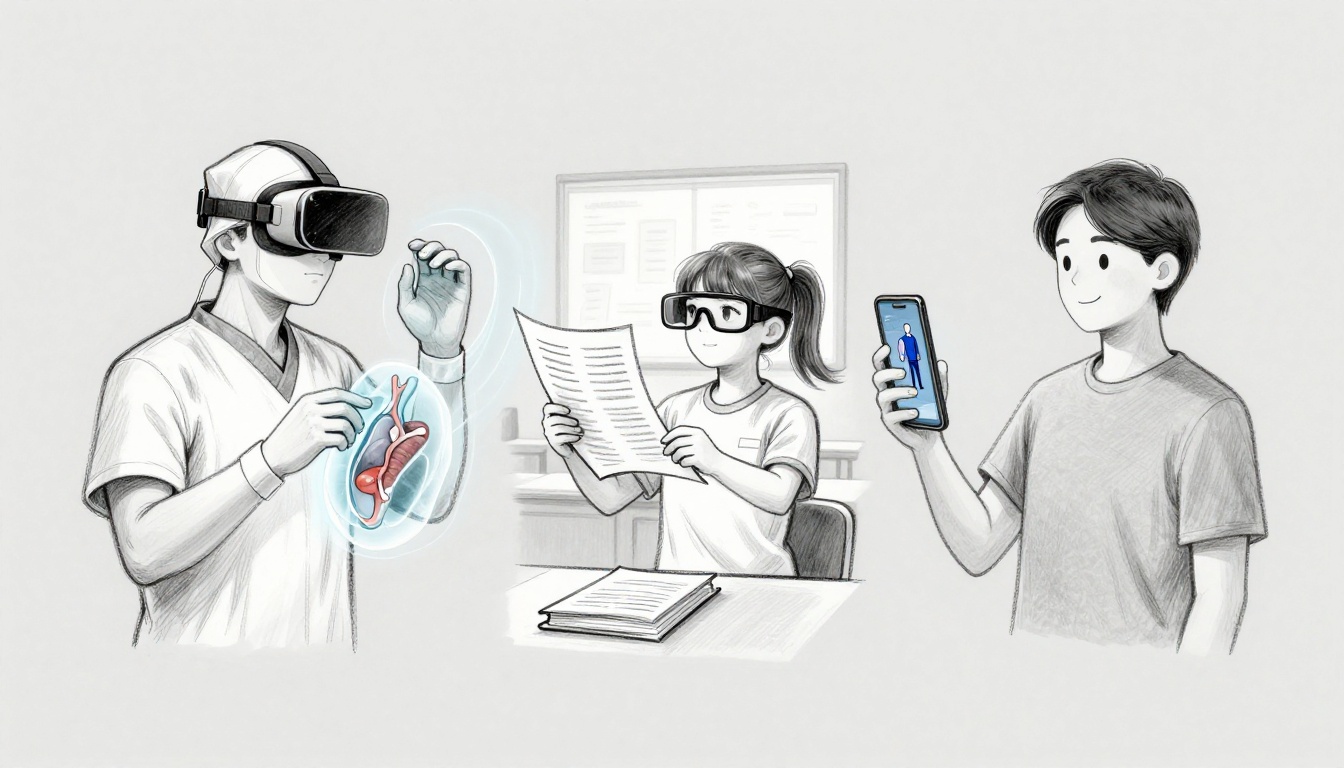
You know that feeling when you want to learn something, but you can’t risk mistakes? Now imagine doing it safely at home, or inside a classroom, using real-world examples of VR and AR.
VR puts you inside a digital scene using a headset. AR adds digital info on top of the real world, usually through phones or smart glasses. Together, they help people practice skills, learn faster, and try products before buying.
In 2026, the biggest changes are not in sci-fi scenes. They show up in hospitals, training rooms, classrooms, and retail apps. And the benefits are pretty practical: fewer risks for trainees, better access for learners, and less guesswork for shoppers.
Keep reading for clear examples across healthcare, gaming, education, and business. You’ll also pick up ideas for how to try VR or AR yourself, even if you’re not a tech expert. Let’s start with the places where these tools can reduce real-world harm.
How VR is Changing Healthcare Forever
Healthcare training used to mean expensive equipment, tight schedules, and limited chances to repeat tricky steps. VR changes that because learners can practice in a safe space, over and over.
In the US, VR adoption keeps growing in schools and hospitals. Recent coverage says over 30% of medical schools use VR for training, and more than 240 hospitals apply it for procedures and patient care.
Here’s what that looks like in the real world.
Training Surgeons Without a Single Cut
One strong example comes from George Washington University Hospital. GW uses VR for surgical practice, including thoracic surgery training, so trainees can run through anatomy and steps before the real thing. You can see their approach through VR Technology in Thoracic Surgery | GW Hospital, Washington, DC.
In addition, GW also describes “Precision Virtual Reality,” which supports practice with 3D anatomy and procedural planning. That focus on repeat practice matters, because each repetition teaches your brain the “where” and “what next.” Learn more at Precision Virtual Reality™ | GW University Hospital.
Meanwhile, companies build VR training that travels with clinicians. For example, Medtronic opened the Medtronic Customer eXperience Center (MCXC) in Singapore, aimed at remote access to technologies and training. Their center is covered in Medtronic Customer eXperience Center. This type of hub helps doctors practice and learn without every person flying for training.
VR isn’t only for surgeons either. Many programs use VR to teach anatomy, CPR skills, and safety scenarios. So trainees can build confidence before they step into real patient care.
Why this is a big deal: VR can reduce risk during early learning, because you’re not working on a live patient.
A few common benefits show up again and again:
- Practice without real risk during the first attempts
- Repeat until it clicks, not until the training slot ends
- Standardized practice, so each learner gets the same scenario
- Faster ramp-up, especially for rare procedures

Helping Mental Health Through Safe Exposure
VR can also support mental health care, especially when someone needs exposure therapy. Exposure therapy works by helping a person face a fear in a controlled way. In VR, the therapist can guide the exposure safely, and the patient can get repeated sessions without leaving the clinic.
Cardiff University’s research has been widely reported for VR-based PTSD treatment using a treadmill setup. Coverage from Cardiff University describes a clinical trial where the guided virtual treatment was effective. See UK researchers pioneer new virtual treatment for PTSD – News. BBC News also covered the results for veterans, including symptom improvement. That report is at Virtual reality PTSD treatment has ‘big impact’ for veterans – BBC News.
So what does that look like in simple terms? A patient walks on a treadmill while VR shows a tailored environment related to their experience. The therapist controls pace and intensity. Over time, the fear response can weaken.

This is also useful for phobias and anxiety. Instead of telling someone “imagine the situation,” VR can put the situation in front of them, with boundaries the therapist can adjust.
One more reason this matters: VR can help people start therapy even when travel or scheduling makes in-person visits hard. That’s especially important for people who live far from specialty clinics.
VR doesn’t replace therapy. It can make exposure work safer and more repeatable.
Making School and Games Unforgettably Fun
If healthcare is where VR reduces risk, schools and games show how VR boosts motivation.
In education, VR supports field trips and practice that would otherwise be too costly, too far away, or too dangerous. In gaming, VR adds a strong sense of presence. When your body feels “there,” your brain pays attention.
Virtual Field Trips That Bring History Alive
A popular example is Google’s education work through Arts & Culture Expeditions. It lets students explore museums and historic places through VR. If you want to see the project directly, start with Arts & Culture Expeditions.
One example collection is also available for specific topics, like Expeditions: Natural History – Google Arts & Culture. Teachers and students can use these experiences to preview sites, explore themes, and spark discussion.
This doesn’t mean every school replaces real trips. Instead, VR helps schools offer options when travel is limited. It also helps students revisit learning later, without waiting for the next field trip day.
In practical classroom terms, VR can answer a question students often ask: “When will I ever use this?” Once they see the real site, dates and names feel less random.

Even outside K-12, universities use VR for skill practice. Recent reporting shows a lot of schools adopting VR to support learning in areas like medicine, engineering, and science.
Dive Deep into VR Gaming Worlds
Gaming is still the most visible use of VR. In recent US data, gaming accounts for about 64% of VR use. That matches what people see in living rooms every day.
Some well-known VR headsets and platforms include Oculus Quest and HTC Vive. Popular games people play include Beat Saber and Half-Life: Alyx. PlayStation VR also brings VR play to console users.

Why do people stick with VR games? It feels different from watching a screen. You move, aim, and react in the same way you do in real life. As a result, learning how controls work gets easier quickly.
And then there’s location-based VR, where you play with your whole body. Sandbox VR is a good example. It offers multiplayer experiences where groups play together in a physical venue. You can see the focus on in-person multiplayer at Multiplayer Games In Person – Sandbox VR.
If you’ve ever tried a co-op game with friends, you already know the appeal. Shared play turns “tech” into a social activity.
Shopping, Work, and Travel Get a High-Tech Boost
Retail is one of the fastest places where AR shows up for everyday people. Instead of guessing how something fits, you can preview it first.
Work and training also benefit. Companies use VR to test processes and practice procedures. For travel and tourism, AR and VR can show places before you go.
In 2026, retail AR keeps expanding. One recent industry estimate puts the AR/VR retail market near $18 billion by 2028.
Try On Anything with AR Mirrors
AR try-on tools let you see clothing, shoes, glasses, or beauty items on your face or body using your phone camera.
For real examples in 2026, you can look at reporting on retailer try-on pilots, including Zara-style virtual fitting experiences described in Zara Virtual Try-On January 2026: Retailers Deploy Interacti. You can also find a broader roundup of examples in 9 VTO Examples Retail 2026.
Another AR try-on example is Clothes – TOUCH TRY, which focuses on virtual try-on for clothing.
The key benefit isn’t just “cool tech.” It can reduce returns. It can also help people decide faster, especially when they shop online.
Here’s a simple way to think about it. Try-on AR acts like a fitting room that never gets busy.

Building and Battling in Virtual Spaces
Manufacturing, military, and architecture all use VR and AR to reduce mistakes. Instead of fixing problems on a real assembly line or in the field, teams can test scenarios in a controlled space.
For manufacturing, VR can simulate tasks, assembly steps, and maintenance procedures. Companies also track progress and errors. That can lead to fewer reworks and safer training.
In the military, VR supports soldier training and scenario practice. AR can also add guidance and overlays to real equipment and environments.
For architecture and real estate, AR and VR shine because people want to “walk through” a space. Instead of only seeing plans, you can view a 3D walkthrough and get a better feel for layout and scale.
And on the enterprise side, adoption is rising. One recent snapshot says over 75% of Fortune 500 companies use VR for training and operations. Many use AR too, often around workflow support and product visualization.
That same logic connects many of these industries. VR helps teams practice. AR helps teams see more, right where they work.
What’s Hot in VR and AR for 2026
In 2026, VR and AR keep moving beyond gaming into day-to-day work and learning.
One trend is more enterprise use. Training keeps expanding because companies want consistent practice and measurable progress. Another trend is “VR/AR hybrids,” where experiences mix headset immersion with real-world visuals for practical tasks. Lucid Reality Labs has also talked publicly about interest in AR glasses and what’s coming next, including device momentum in 2026. Their recent blog post is here: Most Envisioned AR Glasses – Lucid Reality Labs.
Cost is also shifting. Headsets and tools can still be pricey, but more businesses plan pilots and smaller deployments instead of waiting for one perfect system. As a result, you see more proof-of-concept programs in schools, hospitals, and retail labs.
We’re also likely to see more collaboration in tough fields. Think healthcare training, industrial safety, and complex design reviews. When people can share the same virtual view, it’s easier to match expectations.
If you’re searching for emerging VR AR applications, focus on the ones that solve a real problem quickly. Safer training, better product previews, and faster learning show up again and again.
Conclusion
The hook you felt at the start, training without risk, shows up across the best real-world examples of VR and AR. In healthcare, VR supports surgical practice and exposure therapy that helps people face fears safely. In schools and games, VR turns learning and play into something you can feel with your body.
Then retail brings AR into daily life with try-on tools that help shoppers make better choices. Meanwhile, work and travel use VR and AR to test plans, train staff, and preview spaces before they happen.
If you want a next step, pick one use case you care about most. Try a VR app, test an AR try-on, or visit a venue that offers location-based VR. Even one experience can change how you see these tools, and make the future feel a little closer.