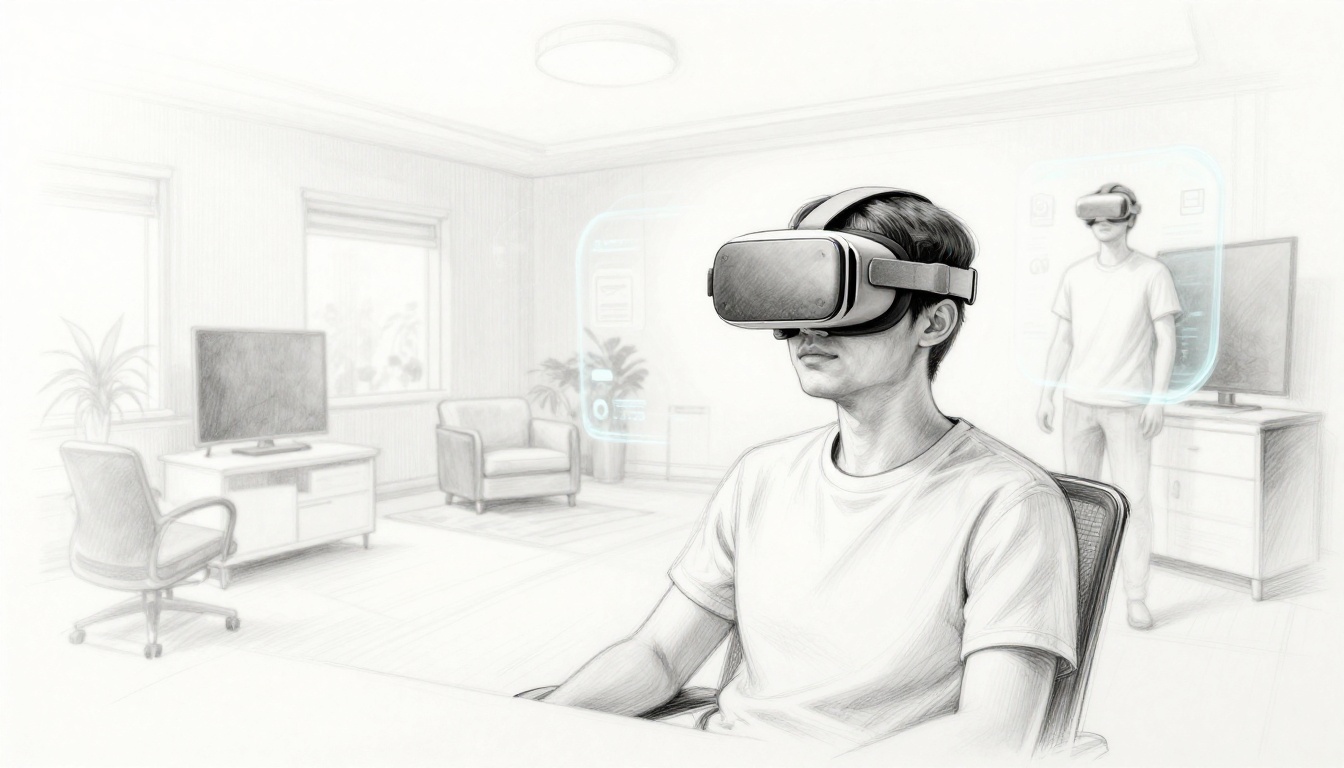
You can’t “half feel” a moment. If you need full focus and real presence, VR usually wins.
AR can add helpful info to your real world. VR can replace the real world with an experience that feels built for your body. That difference matters when people learn skills, practice risky tasks, or just want to lose themselves in play.
In the US, VR adoption keeps climbing. Early 2026 estimates show about 48% of consumers have tried VR, and 13% of households own a VR headset. Meanwhile, AR usage sits lower, with about 30% of Americans using it, often without frequent sessions.
So when should you pick VR instead of AR? Use the switch when you need immersion that blocks distractions, supports physical action, and repeats safely.
How VR Delivers Total Immersion That AR Simply Can’t Match
VR puts you inside a new scene. AR keeps you in your room, then adds digital objects on top.
Here’s the simplest way to see why they differ:
| Feature | VR | AR |
|---|---|---|
| What you see | A full 360-degree world inside a headset | Your real world plus overlays |
| Distractions | Much lower (the real world is mostly blocked) | Often higher (real-world cues stay visible) |
| Interaction | Full presence, natural movement, spatial depth | Quick actions, taps, and “point and view” |
| Best for | Deep practice, emotions, and sustained attention | Fast info, guidance, and everyday context |
| Typical setup | Dedicated headset space | Phone or glasses, often low setup |
Because of that, VR tends to work when you need your brain to treat the experience as real. For a broader comparison of VR and AR, see Virtual Reality vs Augmented Reality key differences.
VR also helps build “muscle memory.” When your hands and body move in sync with what you see, repetition sticks faster than passively reading tips. That’s why VR keeps showing up in training programs and therapy rooms.

That “no distractions” effect is also emotional. You don’t just watch a thing happen. You react to it, dodge it, and feel time move.
Devices and Setup: What Powers VR’s Magic
In 2026, the biggest shift isn’t just better graphics. It’s easier setup.
For most people, Meta Quest 3 is the sweet spot. It’s standalone, so you can use it without a PC. It also supports mixed reality, which means you can see your room when you need to take a break.
If you want a lower-cost entry, Meta Quest 3S is designed for simpler, casual VR sessions. At the other end, Apple Vision Pro targets a more premium experience, with very strong tracking and a sharper display.
There’s also HTC Vive for more “pro” setups, where businesses might want higher-end configurations.
Hand tracking keeps improving too. That matters because it changes how natural the experience feels. Instead of constantly grabbing controllers, you can use your hands in some apps. If you want a practical guide, Meta Quest 3 hand tracking setup is a solid place to start.
Meanwhile, AR often feels like a quick overlay because it depends on your phone or glasses. VR feels like a full session because the headset becomes the main environment.
When you’re trying to decide between VR and AR, ask yourself a basic question: Do you want your attention to stay trapped inside the task? If yes, VR setup often pays off.
Interaction Styles: Full Body vs Quick Overlays
VR interaction tends to be the deciding factor.
With VR, you can look around naturally, reach toward objects, and move your body. The experience responds to you in three dimensions. Over time, your brain learns what your movements should feel like.
AR interaction usually happens through smaller actions. You might tap your screen, scan a marker, or view an overlay while you keep walking around in your real environment.
That’s why some experiences feel “real” only in VR. Imagine training for a dangerous skill. If you need to practice timing, distance, and body positioning, VR supports it in a way AR usually can’t.
It’s also why VR gaming stands out. When you swing a sword or climb a virtual ledge, your movement matches what you see. In AR, many games stay closer to the “screen on top of real life” model.
For a comparison that includes how each tech shapes the future of immersive experiences, you can reference AR vs VR comparison on immersive tech.
Epic Gaming and Entertainment Adventures Exclusive to VR
VR gaming and entertainment offer something AR struggles to copy: full presence.
With VR, you don’t just look at a world. You inhabit it. Your brain handles depth cues and spatial sound in a way that feels like the scene surrounds you. As a result, even short sessions can feel intense.
Also, VR tends to support “full-body” play. You can dodge, duck, crouch, and throw. Even simple movements can add tension and fun.

So if your goal is to feel the rush, VR is usually the better choice.
Games That Pull You Inside the Action
Some VR games work like a physical sport for your brain. You dodge attacks. You react fast. You learn routes by moving your body, not by reading instructions.
That physical connection matters. It turns “I saw it” into “I did it.” Your reflexes improve because you’re repeating the motion in a consistent environment.
You’ll also notice a big difference in how VR handles vertical space. When you lean forward, the scene changes. When you look left, the world shifts instantly. That realism helps you stay calm, even when the game gets busy.
In AR, you can play games, but most experiences keep one foot in your real room. For example, you might place characters around you, then tap to interact. It can be fun, but it usually won’t feel like you’re inside the arena.
Movies and Rides That Feel Personal
VR entertainment can feel like stepping into a story, not watching a screen.
Some VR video formats let you look around in 360 degrees. That creates a stronger sense of immersion than a flat movie, because your attention has room to move. You’re not stuck facing forward.
Theme park style VR rides also benefit from presence. As you lean, turn, or move, the experience reacts. The ride feels personal because your body becomes part of the “camera.”
In AR, a lot of entertainment shows up as filters and overlays. Those can be entertaining for a minute. VR entertainment usually wins when you want longer sessions and a deeper emotional pull.
Master Dangerous Skills Safely with VR Training and Healthcare
If you want the best reason to choose VR, here it is: VR lets people practice without real-world risk.
VR training often improves learning and confidence. One set of findings reports learning gains around 76%, training time reductions up to 75%, and confidence boosts up to 275% compared to classroom settings.
In healthcare, VR training can reduce mistakes. For example, surgeons made about 40% fewer errors in VR-based practice. Many users also report better muscle memory and confidence.
VR also helps with high-stress skills. When people train in a safe simulator, they can repeat until the movements feel natural.
If you’re comparing training approaches, this guide on AR vs VR for training is useful context.
Pro Training in High-Stakes Jobs
Pilots, surgeons, and mechanics all share one problem: repetition is expensive in real life.
VR changes the math. You can rehearse procedures, practice decision-making, and simulate rare situations. Then you can repeat the same scenario without booking time on real gear.
It’s especially helpful for spatial steps. If a task depends on hand positioning, timing, or distance, VR gives you consistent feedback.
Manufacturing can benefit too. In mining scenarios tied to safety, VR training reportedly reduced lost time from injuries by 43%. Overall, VR has also been linked with faster skill training and fewer mistakes.
AR can guide some tasks. For instance, AR overlays can show where to look or what part to examine. Still, AR usually falls short when workers need a full practice space that removes distractions.
Therapy That Conquers Fears
VR isn’t only for jobs and games. It also supports therapy.
Many therapy models rely on controlled exposure. VR helps because the environment stays consistent. Patients can face fears gradually, without putting them in real danger.
Clinics also use VR to practice calming responses and coping skills. Patients can revisit the same safe scene as often as needed. That repetition matters when progress takes time.
In other words, VR can act like a training gym for the mind. You don’t have to “trust your imagination” as much because the scenario is built for the session.
Transform Learning and Work with VR in Education and Manufacturing
VR can turn lessons into experiences.
In education, VR learning has been reported as 76% more effective and 4 times faster than traditional classrooms. Learners also show strong emotional connection, with reported feelings of being 3.75 times more connected to content. Retention rates are often described as staying high months later, with one figure showing 80% retention after a year.
That’s a big deal. Kids and adults don’t remember facts as well when they only hear them. They remember when they act, explore, and connect.
VR also works for work tasks where errors cost time.
Field Trips Without Leaving Class
VR can replace a field trip with something interactive.
A student can walk through ancient places, explore space missions, or observe science in a safe way. Instead of reading a diagram, they can look around and “move through” the concept.
That matters because attention improves when students control the view. They can focus on details that matter to them. Teachers can still lead, but students stay engaged longer.
AR can add labels on top of a textbook or a museum display. Yet VR can place the whole experience inside the learner’s head.
When a trip is expensive, far away, or hard to access, VR becomes a practical option.

Build and Test Products Virtually
Manufacturing and product design benefit from VR when you need to inspect a full 3D space.
Engineers can review a model together. They can check fit, size, and motion. They can also spot problems earlier, before hardware exists.
This is one reason VR works well for training and learning inside a company. People can practice steps and reduce errors before they ever touch real tools.
AR can help with “here is what to do next” guidance on a specific workstation. Still, VR is often better when the job needs deep focus and hands-on inspection in a shared virtual space.
2026 Trends Proving VR’s Edge Over AR
In 2026, VR’s advantages keep getting stronger for a few practical reasons.
First, VR keeps getting easier to wear. New models aim for less weight and better wireless use. Comfort affects how long people stick with the headset.
Second, hand tracking keeps improving. That’s big for everyday interaction. When you can point, gesture, and reach more naturally, VR sessions feel smoother and more intuitive.
Third, AI features are growing in VR. Some updates help experiences feel more personalized. Others improve avatars and guidance inside training contexts.
Market momentum backs this up too. VR adoption is already higher in US households than AR usage, and VR market growth in 2026 is strong. One estimate puts the US VR market around $4.79 billion in 2026, with global growth continuing as well.
Also, AR and MR keep spreading through apps and brands. Still, VR stands out when you want immersion that blocks distractions.
If you’re curious how MR fits in, this breakdown of AR vs VR vs MR differences for 2026 helps clarify what each tech does well.

So, when should you pick VR over AR in 2026? When the goal involves body movement, practice, and deep focus.
Conclusion
Pick VR when you need your attention locked onto the task. It’s the right tool for immersion, safe practice, and learning experiences that feel physical.
AR can be great for quick overlays and everyday info. But VR tends to deliver better results when distractions matter, skills require repetition, and people need a controlled environment.
If you’re deciding what to try, start here:
- Choose VR if you need total focus
- Choose AR if you need fast, in-the-moment guidance
- Choose VR for training that benefits from repetition
- Choose VR if your budget supports a headset-based setup
With VR adoption rising fast, the future of learning and play keeps moving toward deeper experiences. What kind of moment do you want to step into next, training, gaming, or a new way to learn?