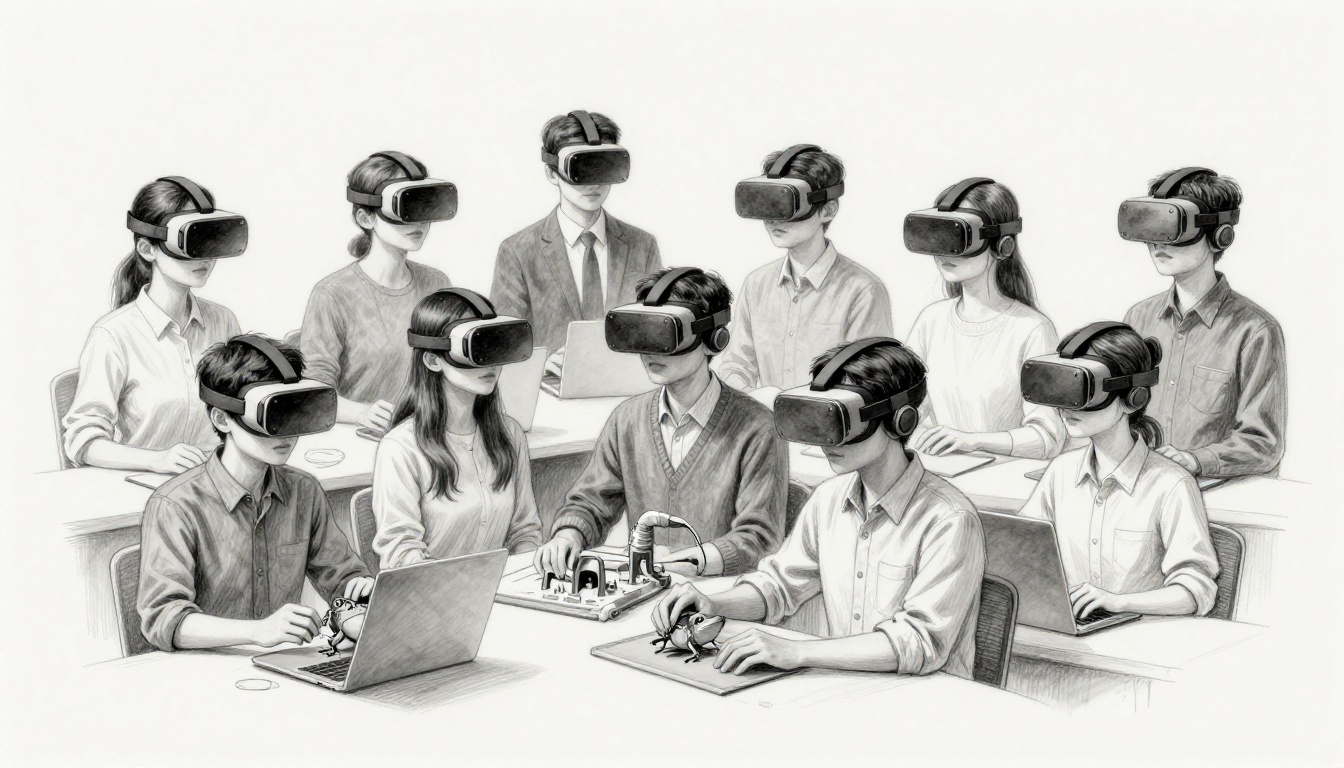
Picture trying to dissect a frog, without the mess, smell, or “please don’t touch that.” Now picture doing it again next week, from the exact same level, with no wasted lab time. That’s the promise of VR (virtual reality) in learning: you wear goggles and enter a realistic digital space where you can look, move, and practice.
In classrooms, VR turns lessons into experiences. Students can visit places they never could, and they can test ideas safely. In college, it supports hands-on practice for labs and real-world roles. In jobs, it helps teams train faster and make fewer mistakes.
But what does that look like in real life, not just theory? This guide breaks down how VR shows up in K-12, college, and workplace training. You’ll see common use cases, real benefits like retention and confidence, plus the tough parts schools and companies run into. By the end, you’ll have a clear picture of what works today and what’s likely next.
How VR Makes K-12 Classrooms More Exciting and Hands-On
K-12 learning already feels busy. Between pacing guides, testing, and limited supplies, teachers need tools that help students stay focused. VR often does that because it makes content feel personal. Instead of watching a video and moving on, students step inside the lesson. In 2026, surveys reported that about 90% of students feel more engaged with VR than with standard formats.
One key reason it works is control. In VR, a teacher can replay a moment, zoom in, or slow down. That matters for students who need extra time. It also helps when a class can’t take a field trip due to cost, safety, or scheduling.
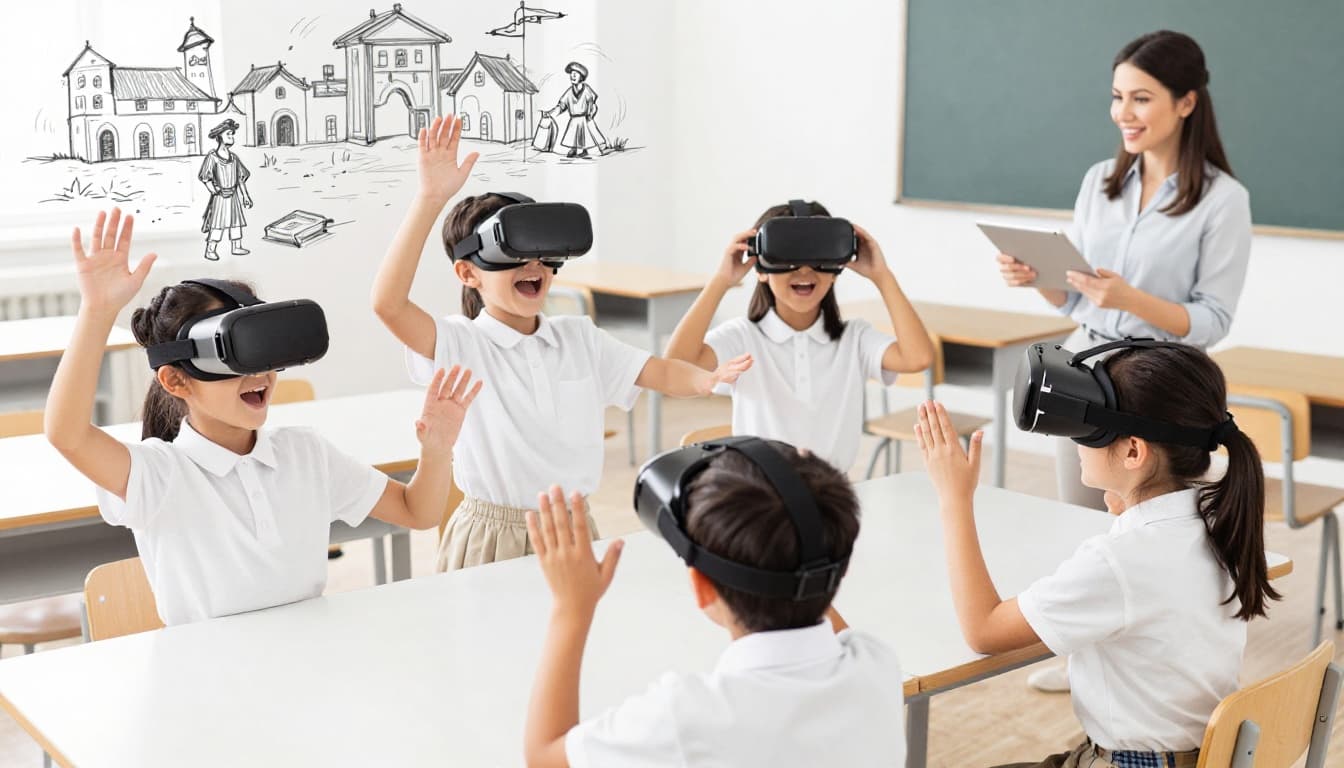
VR also supports learning for different needs. For students who get overwhelmed, many apps include calmer scenes, captions, and reduced motion options. In other words, you can keep the “wow” without pushing students too fast.
Still, VR in schools needs a plan. It’s not just handing out headsets. When districts roll it out well, teachers get clear training and simple classroom routines. For a practical look at implementation, see how K-12 schools can implement AR and VR.
Virtual Trips and History Lessons That Feel Real
Virtual trips can replace a costly bus ride with a guided experience. For history, VR helps kids “walk through” events instead of memorizing dates. For example, some districts use ClassVR to support social-emotional learning alongside history content. In Modesto City Schools, teachers have used ClassVR experiences to help students connect with learning goals in a more immersive way. You can see details in the district case study on ClassVR and Modesto City Schools.
Here’s what that can look like in a fourth-grade lesson:
- Students explore a colonial village layout and examine key buildings from multiple angles
- They answer prompts inside the headset, then discuss what they noticed as a class
- They revisit the same location for review, without needing another trip
The big win is focus. When students feel present, attention holds longer. And when they can repeat the experience, learning sticks.
Safe Science Experiments Kids Can Lead Themselves
Science often runs into real limits. Schools might not have enough microscopes. Certain experiments can be hard to supervise. Other labs are messy or require safety gear.
VR can’t replace every lab, but it can remove the barriers. Students can do virtual dissections, explore human anatomy, or “mix” substances to see outcomes without risk. They also get a chance to practice observation skills, which matter even when the experiment is real.
Teachers can use interactive 3D models to make these activities more hands-on. ClassVR content that connects to ThingLink interactive models can help students explore detailed structures in VR. For an example of how interactive models work in this context, check using ThingLink interactive 3D models in ClassVR.
Another bonus: VR supports creativity, not just recall. Students can record what they learned, revisit key parts, and build confidence before they ever touch real equipment.
VR Powers Up College Courses with Real Practice
College courses ask for deeper practice. You need lab time, real tools, and repeatable instruction. Yet budgets, staffing, and space can slow everything down. VR helps because it gives students a way to practice skills again and again.
In higher education, VR shows up in labs first, especially in STEM. It also shows up in professional training for health, justice, and trades. Many schools use VR for team projects, presentations, and scenario-based learning. That lets students learn communication skills while also learning the subject.
A lot of programs aim for one simple outcome: better preparation before students step into real environments. When learners can rehearse safely, they arrive ready to move faster.
The best part is repeat practice. Students don’t need to “get lucky” with a one-time lab session. They can try again, make mistakes, and correct them right away.
STEM Labs and Simulations That Stick Knowledge Better
STEM classes often include complex systems. Biology, medicine, engineering, and chemistry all have parts that are hard to understand from a slide deck.
VR changes the format. Instead of seeing diagrams, students can inspect models, rotate them, and explore from different viewpoints. That builds a stronger mental map.
Some programs use VR to support student success by adding more lab-like practice. One broad set of examples is covered in Inside Higher Ed’s look at students learning with virtual reality. The key idea is consistent across schools: students get more time in the “do the work” part of learning.
Also, the engagement effect matters here too. With VR training, research summaries often report learning time can drop by 4x, while effectiveness improves. That combination is rare in typical classroom changes.
Creative Projects and Teamwork in Virtual Worlds
VR isn’t only about science. It can support creative projects and teamwork, which are core skills for college life and future jobs.
In VR, teams can build prototypes, test designs, and review each other’s work in shared spaces. Students can “walk through” an architecture concept. They can rehearse a presentation. They can practice professional communication in realistic scenarios.
Colleges also use VR for career exploration. A student can see what a role looks like, then decide if it fits before making a major change. That reduces guesswork and helps students align coursework with real interests.
For example, Austin Peay State University’s Department of Criminal Justice invested in VR to bring students from courtrooms to crime scenes, supported by VR headsets. Their initiative shows how VR can support scenario practice for justice education. You can read about the program here: Austin Peay State University’s VR criminal justice initiative.
Why Companies Use VR to Train Workers Faster and Safer
Workplace training has a pressure schools don’t always feel. If training takes too long, productivity drops. If training errors happen, people can get hurt. VR helps companies because it supports practice without real-world risk.
Many companies see strong training metrics. Across research summaries, VR training often improves retention to around 80% after a year. It also reports big confidence gains, like 275% more confidence to use skills on the job. Learners also report that VR prepares them better, with 95% saying it helps for real tasks like sales or talks.
Those results don’t just come from “cool tech.” VR training tends to be short, focused, and repeatable. A trainee can practice the same procedure multiple times, then get feedback. When you’re training safety steps, repetition saves lives.
For a broader view of what companies report in enterprise VR training, see enterprise VR training and industrial metaverse.
High-Risk Jobs Like Surgery and Police Without Real Dangers
Some jobs require high precision. But real practice can be expensive or risky.
VR can simulate:
- Patient interactions and clinical workflows
- Hazard awareness and evacuation steps
- Incident response planning
- Procedure timing and decision making
This helps trainees build muscle memory. It also helps them learn what not to do. Mistakes become part of the training loop, not a real emergency.
When companies report safety gains, it usually connects to this idea: trainees get more correct practice time before they face real consequences.
A related advantage is standardization. New hires start at the same scenario. That reduces variation across trainers and locations.
Soft Skills and Sales Boosted in Minutes
Not every job needs a hands-on procedure. Many roles need communication skills.
VR helps with soft skills because it can simulate realistic interactions. Learners can practice:
- Public speaking and Q&A
- Customer conversations
- De-escalation and empathy
- Team coordination under pressure
In training research summaries, VR users often report stronger emotional connection to the content. Some findings cite 3.75x more emotional connection with VR than with classroom lessons. That matters, because people remember how a situation felt, not only what they were told.
Real Wins, Tough Hurdles, and VR’s Bright Future in Learning
VR works today, but it comes with tradeoffs. Most programs run into three issues: cost, motion comfort, and teacher readiness.
First, headsets and content cost money. However, the cost can drop with scale. One research summary notes 52% cost savings at 3,000+ learners compared with typical classroom training costs. That’s why large districts and big employers often move first.
Second, some people feel motion sickness. That’s not a reason to drop VR. It’s a reason to pick better experiences. Many tools now offer comfort settings. Teachers can also start with shorter sessions.
Third, adoption takes support. Teachers need quick guidance on lesson flow. Employers need rollout plans for trainers. When training teams handle that well, outcomes improve.
Even with hurdles, momentum keeps growing. In the US, adoption is spreading in both education and work settings. Market forecasts for education VR also keep rising, with VR in education reaching $37.66 billion in 2026 and projected growth through the 2030s.
Standout Success Stories from Walmart to Surgeons
Some of the most convincing VR stories come from measurable training changes.
Research summaries frequently cite improvements like:
- Faster onboarding, with some teams cutting training time dramatically
- Better safety outcomes by practicing hazards in advance
- Higher assessment scores after repeated scenario practice
One widely discussed case is VR onboarding used for frontline roles. For example, Walmart training with VR has been reported as cutting onboarding time for certain roles by compressing hours into minutes. For an additional roundup of company use cases, you can explore companies using VR for training.
Medical training also shows promise. VR practice can help surgeons and nursing students repeat steps and learn error patterns without risking patient care.
In short, when VR training maps to real tasks, results show up in confidence, speed, and accuracy.
Overcoming Costs and Tech Glitches for Wider Use
Wider use comes down to practical fixes.
- Start small: pick one course unit or one job role
- Plan the session length: short VR blocks reduce fatigue
- Prepare the room: headset storage and setup time matter
- Train the teacher: a simple routine beats a complicated workflow
- Choose comfort-friendly experiences: help users adjust without forcing motion
As tech improves, comfort gets better and content gets easier to manage. Also, AI supports smarter tutoring. That means VR could adapt scenarios to the learner’s needs, not just deliver the same experience every time.
If VR is going to work for more people, it needs two things: good setup and fair access. Headsets should become more affordable. Schools need funding and support. Employers need training for instructors, not just for trainees.
Conclusion
You started with a simple hook: learning that feels real. VR delivers that by placing students and workers inside practice scenarios they can repeat safely. In K-12, it powers field trips, hands-on history, and safer science experiments. In college, it supports STEM labs and career prep. At work, it helps teams train faster, retain more, and build confidence.
Yes, there are hurdles like cost and motion comfort. Still, the results reported across education and training show a clear pattern. With the right rollout, VR can turn “practice later” into practice now.
Want to move from hype to action? Try a few free VR apps in short sessions and track what changes. Then share what you learned, especially what worked for your learners. If you care about better, safer training, VR deserves a serious seat in the room.