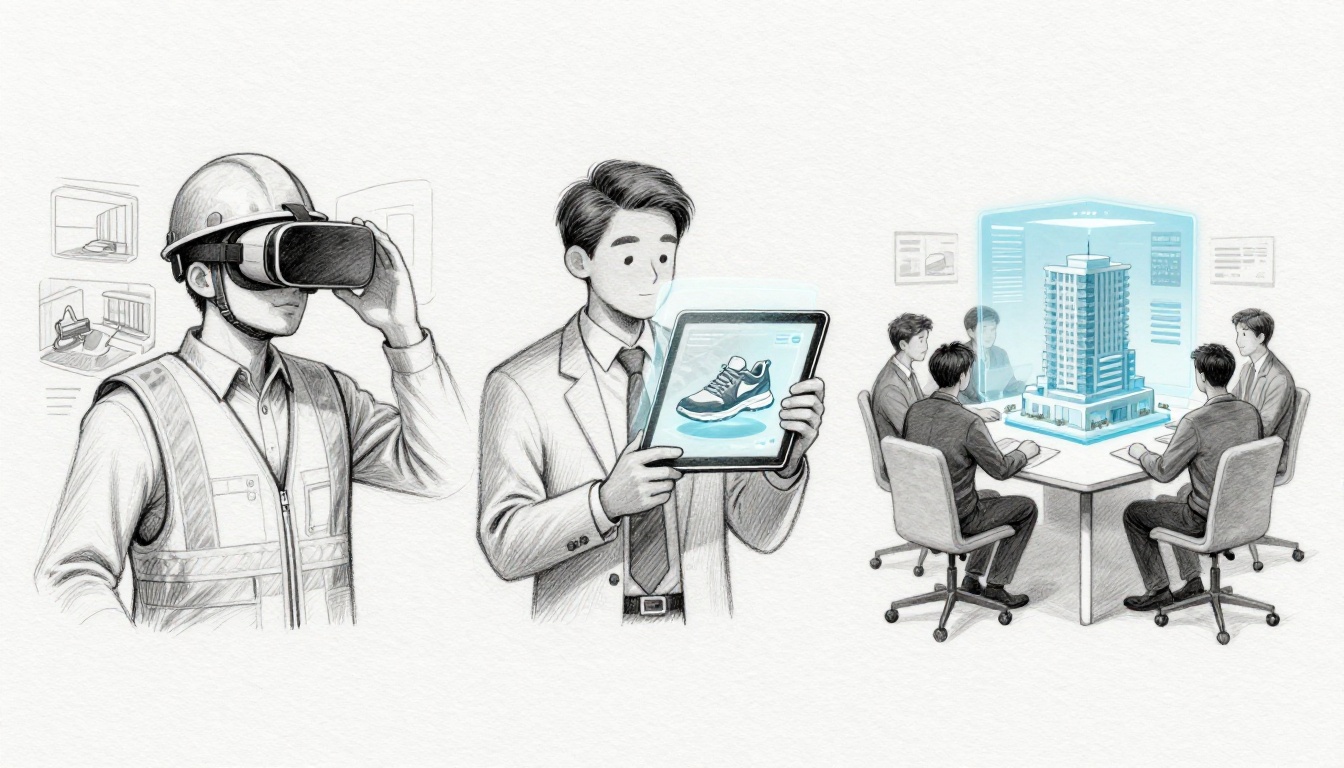
VR and AR have moved past fun demos. In 2026, they’re now used to train teams, sell products, and help people work together faster. Market forecasts also back the momentum, with AR and VR projected to grow into the hundreds of billions by 2033.
Here’s the simple difference. Virtual reality (VR) replaces your view with a fully immersive environment. Augmented reality (AR) keeps you in the real world, then overlays digital details on top.
So where do these tools actually fit into day-to-day business? The most common business applications of VR and AR show up where practice matters, where customers need clarity, and where teams need shared context. You’ll see VR used for training in high-risk jobs. You’ll see AR used for try-ons and product previews. You’ll also see both used for tours, planning, and collaboration across locations.
In the sections below, you’ll get practical examples in training, retail, real estate, and remote work. You’ll also learn how to start small without waiting for a “perfect” rollout.
How VR Simulations Are Revolutionizing Employee Training
VR training business applications work because they let people practice without real-world risk. Instead of watching a video, trainees step into the task. Then they repeat it until it feels natural.
That matters in jobs where one mistake can cost time, money, or even safety. For example, pilots can rehearse emergencies. Factory staff can learn machine steps without locking in downtime. Medical teams can practice scenarios before stepping into real operating rooms.
Industry projections show strong growth in immersive training, and research trends point to real learning improvements. One summary of published findings reports VR can help learners move faster, with learning up to 4x and errors down around 40% in areas like healthcare and industrial training.
Here’s what makes VR training practical for many companies:
- Safety first: trainees can make mistakes and recover instantly
- Consistent coaching: every employee gets the same scenario and cues
- Faster onboarding: practice replaces long “watch and hope” time
- Better tracking: firms can measure completion, timing, and error points
In addition, some enterprise platforms now mix VR with AI-assisted simulation. That means scenarios can adapt based on how someone performs, not just what they clicked. If you want a sense of how vendors describe AI-powered XR training workflows, see EON Reality’s AI-powered simulation approach.

Real-World Wins in Manufacturing and Aviation
Manufacturing training often fails for one basic reason, people can’t “practice everything” on real equipment. VR fixes that by simulating the workflow. Workers can run through startup steps, safety checks, and troubleshooting.
The payoff shows up in fewer incidents and less downtime. When employees already know the sequence, they waste less time during their first real shift. They also handle edge cases with more confidence.
Aviation training works similarly, though the stakes are higher. Instead of grounding aircraft for repeated practice, training teams can run VR simulations of abnormal events. That includes everything from warning lights to emergency procedures. As a result, trainees walk into real scenarios with muscle memory, not first-time confusion.
Training events and ROI conversations also reflect this shift toward immersive learning. If you like to compare real programs and business results, check Enterprise XR Training Conference 2026.
Healthcare Training That Saves Lives
Healthcare teams use VR to rehearse clinical tasks in controlled conditions. Surgery is the headline use case, but the training value extends beyond the operating room.
With VR sims, clinicians can review anatomy from multiple angles. They can practice steps in high-pressure scenarios. Then they can repeat the simulation until their decisions feel steady.
Why do people remember VR practice better than books or videos? Because it’s interactive. Instead of passively consuming info, trainees make choices and see the outcome. That active loop strengthens recall and helps teams spot what “good” looks like.
In other words, VR doesn’t just teach a process. It teaches judgment. And when people practice judgment safely, patient outcomes improve later.
AR Try-Ons and Virtual Showrooms: Supercharging Retail Sales
AR retail applications solve a common problem: customers can’t always “see it in their life” before buying. AR bridges that gap by placing products in a real setting on the shopper’s phone or device.
In 2026, this trend has expanded beyond custom apps. Many brands use web-based AR, often called WebAR. That means shoppers can preview items with less friction, sometimes straight from a product link.
Then you get the payoff: fewer doubts, stronger intent, and more confident purchases.
AR works especially well for products with size, fit, or visual style questions. Furniture, cosmetics, eyewear, and home decor fall into this group.
For example, AR try-ons let customers see what a makeup shade looks like on them. Furniture placement tools let shoppers visualize a sofa or lamp in their room. And photoreal previews help shoppers trust the product before they commit.

Here’s where this turns into business results:
- Higher engagement because customers interact, not scroll
- Fewer returns because visual mismatch drops
- More repeat buys when shoppers feel confident
- Stronger brand trust when products match expectations
If you want a rundown of how try-on tech fits into retail workflows, see virtual try-on solutions for AR shopping.
IKEA and Sephora Leading the Way
IKEA is a classic example because its AR furniture placement helps customers confirm dimensions and style. Instead of imagining scale, buyers see how pieces fit in their rooms. This kind of preview also reduces “surprise” at delivery, which often leads to returns.
Sephora has helped popularize AR try-ons for makeup. The goal is simple: let shoppers preview shades and styles fast. When customers see how a product looks on them, they move from browsing to buying with less hesitation.
The key detail isn’t only the technology. It’s how easy it feels. In retail, if the preview step takes too long, it loses its value.
Gamification Making Shopping Addictive
AR experiences also work when brands add light game elements. Think about “collect and unlock” prompts. Think about playful filters. Think about challenges that match product categories.
This works because AR makes shopping feel less like a task. It becomes something you want to try now, not later.
It also supports personalization. When the app learns what a shopper tries, recommendations can feel more accurate. That can reduce decision fatigue, especially for customers who compare many options.
Still, the best AR gamification stays relevant. It should guide customers toward the product, not distract them from it.
Virtual Tours and Immersive Collaboration: Real Estate and Remote Work
VR real estate use cases focus on decision-making. Buyers want to know how a space feels. They also want answers about layout, light, and flow.
A VR walkthrough can do that from anywhere. Instead of traveling for every viewing, buyers can explore virtually first. Then they shortlist properties more quickly.
Remote work teams benefit too. When people can meet in shared 3D spaces, collaboration can feel more natural than a grid of video windows. That can help with brainstorming, whiteboard work, and real-time design review.
Even where companies already use Zoom or Teams, VR spaces add a new option. It supports group presence. It also encourages “show me” moments, not just “talk through it.”

For tools and examples, Meta’s work content explains how Horizon Workrooms supports VR meeting spaces and shared work tools. You can see the basics here: Horizon Workrooms for VR remote collaboration.
Selling Homes Faster with VR Walkthroughs
A VR walkthrough can shorten the “back and forth” that slows deals. Buyers can check layout and room flow early. Agents can show more details without scheduling constant trips.
This also helps out-of-town buyers. They can narrow down options before they book travel. Then, when they do visit, they often spend less time on properties that do not fit.
For sellers, it can reduce wasted showings. For buyers, it can reduce uncertainty. For agents, it can support higher-quality conversations.
Teamwork in Virtual Offices Beats Zoom
VR collaboration can beat standard calls in two ways. First, shared space makes discussions easier. A team can gather around a 3D model. They can point to parts and move through scenarios together.
Second, VR meetings can feel less tiring when teams use the right format. Short sessions can support focus. Larger sessions can support co-creation, like sketching layouts or reviewing designs.
Also, not every team needs VR. But many teams do need better context sharing. If people struggle with “Where exactly are you looking?” VR can reduce that gap.
To explore more practical VR meeting use cases, see mixed reality meetings and collaboration.
Marketing Magic and the Road Ahead for VR and AR in Business
Marketing is where VR and AR can feel most “visible” to customers. AR ads can place a product in your space. VR can offer immersive storytelling and guided experiences. Both can help brands get attention, but the better goal is attention with meaning.
Immersive marketing matters because it supports product understanding. If someone can see how a product works in their environment, they trust it sooner. If they can explore a space or story firsthand, they remember it longer.
AR Insider highlights why immersive marketing keeps growing, including interactive lenses and virtual try-on experiences. If you want a marketing-focused look at what’s driving the trend, read what immersive marketing is and why it matters.

So what should businesses do in 2026?
Start with one use case tied to a clear metric. Then build from there. You can measure training outcomes, return rates, conversion, or time saved in meetings.
A smart next move is to pilot with a small group. Then improve based on feedback. If users say it takes too long, simplify the steps. If they say the visuals help, expand the scenarios.
VR and AR are still maturing. But adoption is no longer the main question. The main question is whether you pick an application that fits your goals.
Conclusion
VR and AR work best in places where decisions need proof. In practice, that means VR for training (safety, repetition, and measurement) and AR for retail (try-ons, visual fit, and faster buying). It also shows up in real estate tours and remote collaboration, where shared context beats confusion.
If the hook in this post was “VR and AR are must-have tools now,” hold onto that. Choose one business application, run a small pilot, then track results. Even a modest rollout can cut risk and improve outcomes.
What’s the first workflow in your company that would benefit from a safer simulation or a clearer visual preview? Share that idea, and you’ll be closer to a plan than most teams are today.